

Knowledge Begins with the Correct Foundation
Begin learning Islam with the foundations of belief and worship: Tawhid, the two testimonies, Islam, iman and ihsan. Understand their evidence, connect what you learn to sincere practice, then choose one suitable next study.
فاعلم أنه لا إله إلا الله واستغفر لذنبك
Translation of the Meaning
“So know that none has the right to be worshipped except Allah, and seek forgiveness for your sin.”
Start first establishes the religion from its governing evidence. Books, courses and study tools come later as servants of that foundation—not as substitutes for it.
Why knowledge comes first
The explanations use concise questions and answers to establish meaning before application, a method illustrated in al-Sa‘di’s Questions and Answers on the Most Important Matters. Read al-Rajihi’s explanation of its opening questions (Arabic).
Pause and Ask Allah
اهدنا الصراط المستقيم
Translation of the Meaning
Guide us to the Straight Path.
Qur’an 1:6 · Explanatory translation of the meaning. A supplication from al-Fatihah.
Why You Were Created
Allah created you to worship Him. Learn what worship means, why it belongs to Him alone and how belief in your Lord directs your life.
What is worship?
Worship — العبادة — includes the inward and outward words and deeds Allah loves and accepts. Prayer, supplication, love of Allah, hope in His mercy and obedience to His commands belong together.
Ordinary fear of danger and lawful help from someone able to assist are not automatically worship. The meaning and circumstances matter.
Explanation based on Ibn Baz, The First Principle: worship and its kinds.
What is Tawhid?
Tawhid — التوحيد — is to single Allah out in what belongs uniquely to Him: His lordship, His right to worship, and His names and attributes. These three categories describe one foundation; affirming Allah as Creator does not permit directing worship to another.
Ibn Baz: the categories of Tawhid
Shirk is giving another a share in what belongs uniquely to Allah. Directing worship to another is major shirk. Recognize this to keep your own worship sincerely for Allah; judgments about particular people require the safeguards explained later. Study belief and what contradicts it.
وما خلقت الجن والإنس إلا ليعبدون
Translation of the Meaning
“I did not create the jinn and mankind except that they worship Me.”
ولقد بعثنا في كل أمة رسولا أن اعبدوا الله واجتنبوا الطاغوت
Translation of the Meaning
“We certainly sent into every nation a messenger: Worship Allah and avoid ṭāghūt.”
Established meaning
What is taghut?
Taghut refers to that through which a person exceeds the proper bounds in worship, following or obedience. Here the command is to reject false objects of worship and worship Allah alone. A prophet, angel or righteous servant who rejects being worshipped is not made a taghut by another person's false worship.
Ibn Baz: rejecting taghut · Study the meaning with explanation
Worship belongs
to Allah alone.
Single Allah out in every act of worship: your prayer, supplication, sacrifice, hope, fear and reliance. This is the purpose for which you were created and the call of every Messenger.
Open the meaning & evidence
الله لا إله إلا هو له الأسماء الحسنى
Translation of the Meaning
“Allah—none has the right to be worshipped except Him. To Him belong the most beautiful names.”
Qurʾān — Ṭā Hā 20:8 · translation of the meaningDirect worship to Allah alone, and reject worship of anything besides Him. Knowing that Allah is your Lord is inseparable from giving Him alone this right.
Scholarly explanation — Shaykh Ibn BāzOne Tawḥīd. Three inseparable categories.
Al-ulūhiyyah brings the purpose of your creation into focus. Alongside it, affirm Allah’s sole lordship and His names and attributes. These categories belong together; they are not successive stages.
الربوبيةAllah alone is the LordTawḥīd al-RubūbiyyahHe alone creates, owns, provides and governs every affair.Explore the meaning & evidence
يا أيها الناس اعبدوا ربكم الذي خلقكم والذين من قبلكم لعلكم تتقون
Translation of the Meaning
“O mankind, worship your Lord, who created you and those before you, so that you may attain taqwā.”
Qurʾān — al-Baqarah 2:21 · translation of the meaningThe One who created and sustains you is the One you must worship. Acknowledging Allah as Creator while directing worship to others does not fulfil Tawḥīd al-ulūhiyyah.
Scholarly explanation — Shaykh Ibn Bāzالأسماء والصفاتTo Him belong the most beautiful namesTawḥīd al-Asmāʾ wa al-ṢifātKnow Allah through the names and attributes He has revealed.Explore the meaning & evidence
ليس كمثله شيء وهو السميع البصير
Translation of the Meaning
“There is nothing like Him, and He is the All-Hearing, the All-Seeing.”
Qurʾān — al-Shūrā 42:11 · translation of the meaningAffirm what Allah established for Himself in the Qurʾān and what His Messenger ﷺ established in the authentic Sunnah, in a manner befitting Allah—without distortion, denial, asking how, or likening Him to creation.
Scholarly explanation — Shaykh Ibn BāzThe Qurʾān calls you to Tawḥīd.
Knowing Allah, worshipping Him, obeying His commands, and understanding the final outcome—all return to this foundation.
Read Ibn al-Qayyim’s explanation
فالقرآن كله في التوحيد وحقوقه وجزائه، وفي شأن الشرك وأهله وجزائهم
Translation of the Meaning
“The whole Qurʾān concerns Tawḥīd, its rights and its recompense, and the matter of shirk, its people and their recompense.”
Ibn al-Qayyim, Madarij al-Salikin — passage read in Ibn Baz’s commentary- Knowing Allah: His names, attributes and actions.
- Worshipping Him alone: leaving everything worshipped besides Him.
- Fulfilling His commands: the rights and completion of Tawḥīd.
- His honouring its people: the reward of Tawḥīd and obedience.
- The outcome of shirk: the punishment described for those who oppose Tawḥīd.
The weight of the testimony
فتوضع السجلات في كفة والبطاقة في كفة فطاشت السجلات وثقلت البطاقة فلا يثقل مع اسم الله شيء
Translation of the Meaning
“The records are placed in one pan and the card in another. The records rise and the card weighs heavy; nothing outweighs the name of Allah.”
Jāmiʿ al-Tirmidhī 2639 — ḥasan gharīb according to al-Tirmidhī; ṣaḥīḥ in the Darussalam gradingThis is the account of a man whose card bears the two testimonies and outweighs ninety-nine records. It shows the greatness of Tawḥīd; it is not a promise that words uttered without sincerity excuse abandoning worship.
In Ṣaḥīḥ al-Bukhārī 99, the Prophet ﷺ describes the person most fortunate to receive his intercession as one who says لا إله إلا الله sincerely from the heart.
Read the authentic ḥadīth on sincerityWorship Allah Alone
Follow His Messenger ﷺ
Allah alone is worshipped, and He is worshipped according to the guidance brought by His Messenger ﷺ.
None has the right to be worshipped except Allah alone
It rejects worship of everything besides Allah and affirms worship for Him alone.
Muḥammad is the Messenger of Allah ﷺ
قل إن كنتم تحبون الله فاتبعوني يحببكم الله ويغفر لكم ذنوبكم
“Say: If you love Allah, then follow me; Allah will love you and forgive you your sins.”
Meaning and requirements of Muḥammad Rasūl Allāh
Sincerity and following
A testimony to live by
The shahadah is a testimony made with knowledge and belief: none has the right to be worshipped except Allah alone. Its negation rejects worship of everything besides Him; its affirmation gives worship to Him alone.
The Sunnah is the guidance transmitted from the Messenger ﷺ in his sayings, actions and approvals. The authentic Sunnah is revelation from Allah and is binding evidence alongside the Qur’an. Following him includes believing his reports, obeying his commands, avoiding his prohibitions and worshipping Allah as he taught.
The four requirements are a scholarly explanation, not a hadith quotation: The Second Principle, with Ibn Baz’s explanation. The authority of the Sunnah: Abu Dawud 4604, graded sahih by al-Albani.
Sincere intention and correct following belong together. Seek Allah’s acceptance and check that your worship follows the Messenger’s guidance. Qur’an 18:110 · Sunnah and Manhaj
The Pillars of Islām
The religion is not only understood—it is established in worship. The five daily prayers therefore appear before the extended book curriculum.
What is Islam?
Islam is submission to Allah through Tawhid, obedience to Him and rejection of shirk. Its five pillars are central duties within a religion that also governs belief, character and daily conduct.
The Second Principle · Sahih Muslim 8a
The quoted narration of al-Bukhari lists Hajj before fasting; the teaching cards follow the order in Muslim’s Hadith Jibril. Both reports are authentic. Learn purification and the five daily prayers now, alongside your foundational study. The instruction to Mu‘adh: Sahih al-Bukhari 1395.
بني الإسلام على خمس شهادة أن لا إله إلا الله وأن محمدا رسول الله وإقام الصلاة وإيتاء الزكاة والحج وصوم رمضان
Translation of the Meaning
“Islam is built upon five: testifying that none has the right to be worshipped except Allah and that Muḥammad is Allah's Messenger, establishing prayer, giving zakāh, ḥajj, and fasting Ramaḍān.”
The Two Testimonies
Established above — the first pillar.
Ṣalāh
Establish the five daily prayers. Learn their times, purification and correct performance.
Learn Prayer NowZakāh
Give the obligatory due from qualifying wealth when its conditions apply.
Ramaḍān
Fast the month according to the rulings Allah legislated.
Ḥajj
Perform pilgrimage to the Sacred House when able.
The Prophet ﷺ said buniya al-Islām — “Islam is built.” The five are foundational supports, not an exhaustive list of everything Islam commands.
The narration of Muʿādh establishes Tawḥīd first and then immediate instruction concerning the five obligatory prayers. It governs this page’s priority, not a rigid universal textbook syllabus.
The Six Pillars of Īmān
After Islām is established in the order of Ḥadīth Jibrīl, the page turns to the six foundations named in the Prophet’s ﷺ answer concerning Īmān.
What is iman?
Iman includes the heart’s belief and worship, the tongue’s confession and the limbs’ deeds. It increases through obedience and decreases through disobedience; faith is therefore nurtured through knowledge and practice.
Ibn Baz: iman comprises belief, speech and action, and increases and decreases
أن تؤمن بالله وملائكته وكتبه ورسله واليوم الآخر وتؤمن بالقدر خيره وشره
Translation of the Meaning
“That you believe in Allah, His angels, His Books, His Messengers, the Last Day, and divine decree—its good and its evil.”
Belief in Allah
Belief in Allah, His lordship, His exclusive right to worship, and His names and attributes.
His Angels
Belief in the honored servants Allah created and in what revelation authentically tells us about them.
His Books
Belief in the revealed Books Allah sent as guidance to His messengers.
His Messengers
Belief in all Allah’s messengers, with Muḥammad ﷺ as the final messenger.
The Last Day
Belief in resurrection, judgment and what is authentically reported concerning the Hereafter.
Divine Decree
Belief in divine decree—its good and its evil—as stated in the hadith.
Understanding divine decree
Allah knows all things, has written what will occur, wills whatever takes place and is the Creator of all things. You also have a real will and responsibility under His will. Belief in decree calls you to seek His help and take lawful means; it does not excuse sin or neglect of duty.
Qur’an 54:49 · Qur’an 81:28–29 · Sahih Muslim 2664
Allah wrote the decrees: Sahih Muslim 2653bIslām · Īmān · Iḥsān
Islam, iman and ihsan are connected within one religion. Hadith Jibril joins what you have learned about submission and faith to excellence in worship.
Islām
The two testimonies, prayer, zakāh, fasting Ramaḍān and ḥajj for the one able.
Īmān
Belief in Allah, His angels, His Books, His Messengers, the Last Day and divine decree.
Iḥsān
أن تعبد الله كأنك تراه فإن لم تكن تراه فإنه يراك
Worship Allah as though you see Him; and if you do not see Him, He sees you.
فإنه جبريل أتاكم يعلمكم دينكم
Translation of the Meaning
“It was Jibrīl; he came to you to teach you your religion.”
Read the complete ḥadīth and distinctions
When Islam and iman appear together in this hadith, their distinct emphases become clear: the acts of submission and the foundations of belief. Used separately, either term can encompass the religion more broadly. Ihsan describes excellence in worship; it does not replace the obligations already taught.
Iḥsān
After Islām and Īmān, Ḥadīth Jibrīl turns to the excellence and watchfulness with which Allah is worshipped.
أن تعبد الله كأنك تراه فإن لم تكن تراه فإنه يراك
Translation of the Meaning
“That you worship Allah as though you see Him; and if you do not see Him, He sees you.”
Start introduces the Prophetic definition. The detailed worship of the heart—sincerity, repentance, love, fear, hope, reliance and related purification—continues in Tazkiyat al-Qalb.
Develop Iḥsān → Tazkiyat al-Qalb →Let knowledge reach the heart
Ihsan calls you to worship with sincerity and awareness that Allah sees you. Before prayer, recall whom you are standing before; during it, return your attention to what you say and do.
Tazkiyah — التزكية — is purification and growth of the soul through faith, obedience and leaving sin. Ask Allah to purify your heart, repent when you fall short and work on the duty in front of you.
Upon the Way of the First Believers
The Companions learned the Qurʾān and Sunnah directly from the Messenger ﷺ and transmitted the religion to those after them.
The Salaf al-Salih are the righteous early generations, foremost the Companions, then those who followed them and the generation after them upon goodness. Their transmitted understanding helps us receive the Qur’an and Sunnah as taught, rather than reshape them around personal preference.
Manhaj means the path or method followed. Here it is the way of receiving, understanding and applying revelation with the guidance of the Salaf. Learn about the Salaf · Study Sunnah and Manhaj
والسابقون الأولون من المهاجرين والأنصار والذين اتبعوهم بإحسان رضي الله عنهم ورضوا عنه
Translation of the Meaning
“The first and foremost of the Muhājirūn and Anṣār, and those who followed them with excellence—Allah is pleased with them and they are pleased with Him.”
خير الناس قرني ثم الذين يلونهم ثم الذين يلونهم
Translation of the Meaning
“The best people are my generation, then those who follow them, then those who follow them.”
Learn with Understanding
Let sincere learning become sound belief, worship and conduct.
Abu ‘Abd al-Rahman al-Sulami reported from those who taught them the Qur’an that they learned ten verses and did not move beyond them until learning the knowledge and action they contained.
Report from the early generations, paraphrased. Musnad Ahmad 23482; al-Badr describes its chain as sound in al-Tibyan, printed p. 49 / PDF p. 50.
Learn Sincerely
Ask Allah for beneficial knowledge. Learn to worship Him correctly and remove ignorance from yourself, rather than to gain admiration or win arguments. Before your next lesson, renew your intention.
Understand Correctly
Read the evidence with its explanation. Ask what the words mean, what they establish and which distinctions matter. If something is unclear, write the question down and ask a reliable teacher before applying it.
Act upon Knowledge
Begin with the duty the lesson makes clear. Learning about prayer should lead you to correct your purification and prayer; learning about sincerity should change whom you seek to please. Do not postpone an obligation while completing a reading list.
Remain Consistent
Keep a manageable time for study and review. Return to the evidence, check your understanding and maintain the good you have learned. When you fall short, repent and resume; the most beloved deeds are those maintained, even when small.
Continue with Guidance
Strengthen what you already understand before moving to harder material. Take the next suitable lesson, seek correction from qualified teachers and convey only what you know accurately. Sound learning grows with patience, practice and review.
These five steps organize the learning path; they are not a new religious enumeration. The introduction to the Three Fundamental Principles connects knowledge, action, calling to it and patience.
Pause and Ask Allah
رب زدني علما
Translation of the Meaning
My Lord! Increase me in knowledge.
Qur’an 20:114 · Mustafa Khattab, The Clear Quran. A supplicatory excerpt from this verse.
The Scholars Explain
فإن العلم خير، وكثرة الخير مطلوبة
“Knowledge is good, and an increase in good is sought.”
Al-Sa‘di joins asking Allah for knowledge to effort, eagerness and dependence upon Him. The verse also teaches patience while receiving revelation; approach your teacher with that care.
Al-Sa‘di, tafsir of 20:114 · explanation and translation of the quoted phrase.
Find Your Place and Build the Foundations
Choose where you are now, then enter the foundational studies that develop what revelation has already established.

I need the foundations clearly.
Tawḥīd, the testimonies, Islām/Īmān/Iḥsān, prayer and concise foundational study.
Learn the Foundations
I know the basics and need structure.
Foundational works, ʿAqīdah & Īmān, and disciplined study.
Book Studies
I studied before and need consolidation.
Evidence, meanings, memorization, practice and structured review.
Review & StrengthenBuild the Foundations
Study one concise work carefully. These books explain foundations established by revelation; the learning sequence is educational guidance, not a prescribed religious order.
The five introductory texts are by Muhammad ibn ‘Abd al-Wahhab. The teachers and commentators of the linked English series are identified below each title.
The Three Fundamental Principles
Know your Lord, your religion and your Prophet. Moosaa Richardson reads the text with Ibn ‘Uthaymin’s explanatory notes; hosted by the Tarbiyah Initiative of South Florida.
Explore this English seriesConditions of La ilaha illa Allah
Study the knowledge, certainty and sincerity required by the testimony. Moosaa Richardson teaches from Muhammad Aman al-Jami’s explanation, Toronto, 2014.
Explore this English seriesThe Four Principles
Clarify the difference between recognizing Allah’s lordship and worshipping Him alone. Read and translated by Salaah Brooks, supervised and explained by Moosaa Richardson.
Explore this English seriesThe Meaning of Taghut
Develop the brief definition with its evidence and necessary distinctions. Taught by Moosaa Richardson at al-Masjid al-Awwal, Pittsburgh.
Explore this English seriesThings That Nullify Islam
Study what contradicts the foundation with qualified explanation and the safeguards below. Moosaa Richardson reads Muhammad Aman al-Jami’s explanation.
Explore this English series
Continue later with Kitab al-Tawhid
When the introductory foundations are understood, deepen your study with a suitable explanation of Kitab al-Tawhid. Choose a resource with a teacher appropriate to your level and a language you understand.
Explore the Foundations study gatewayLooking for family or teaching support? Find the children’s, youth, parents’ and educators’ routes. For immediate practical help, use New to Islam.
Learn What Opposes and Endangers It
After Tawḥīd, Islām, Īmān, Iḥsān and obligatory worship have been established, the learner studies what contradicts, damages or nullifies that foundation at the appropriate level.
Recognize Shirk
Learn what contradicts worship of Allah alone.
The Four Principles
al-Qawāʿid al-Arbaʿ sharpens important distinctions concerning Tawḥīd and shirk.
Know the Nullifiers
Study Nawāqiḍ al-Islām carefully and with qualified explanation.
Guard Worship
Return continually to the Sunnah and avoid introducing acts into religion.
What is shirk? Shirk is giving another a share in what belongs uniquely to Allah. Directing worship to another is major shirk. Learn its meaning to purify your own worship, with care about the distinctions already explained.
Guard Worship. Good intentions do not make an invented religious practice part of the Sunnah. Check how the Messenger ﷺ taught the act, and seek reliable explanation when uncertain.
Ibn Baz on worship and shirk · Sahih al-Bukhari 2697 · Ibn ‘Uthaymin: safeguards in judgments of disbelief
Build and protect your own foundation through studyArticles and Short Benefits
Selected articles to deepen your understanding of the foundation.
Renew Your Intention Before You Study
The value of a deed is bound to the intention behind it. Before opening a lesson, ask yourself whom you seek to please. Seek Allah’s acceptance and the knowledge needed to worship Him correctly.
Site explanation based on Sahih al-Bukhari 1.
Connect intention to your learning steps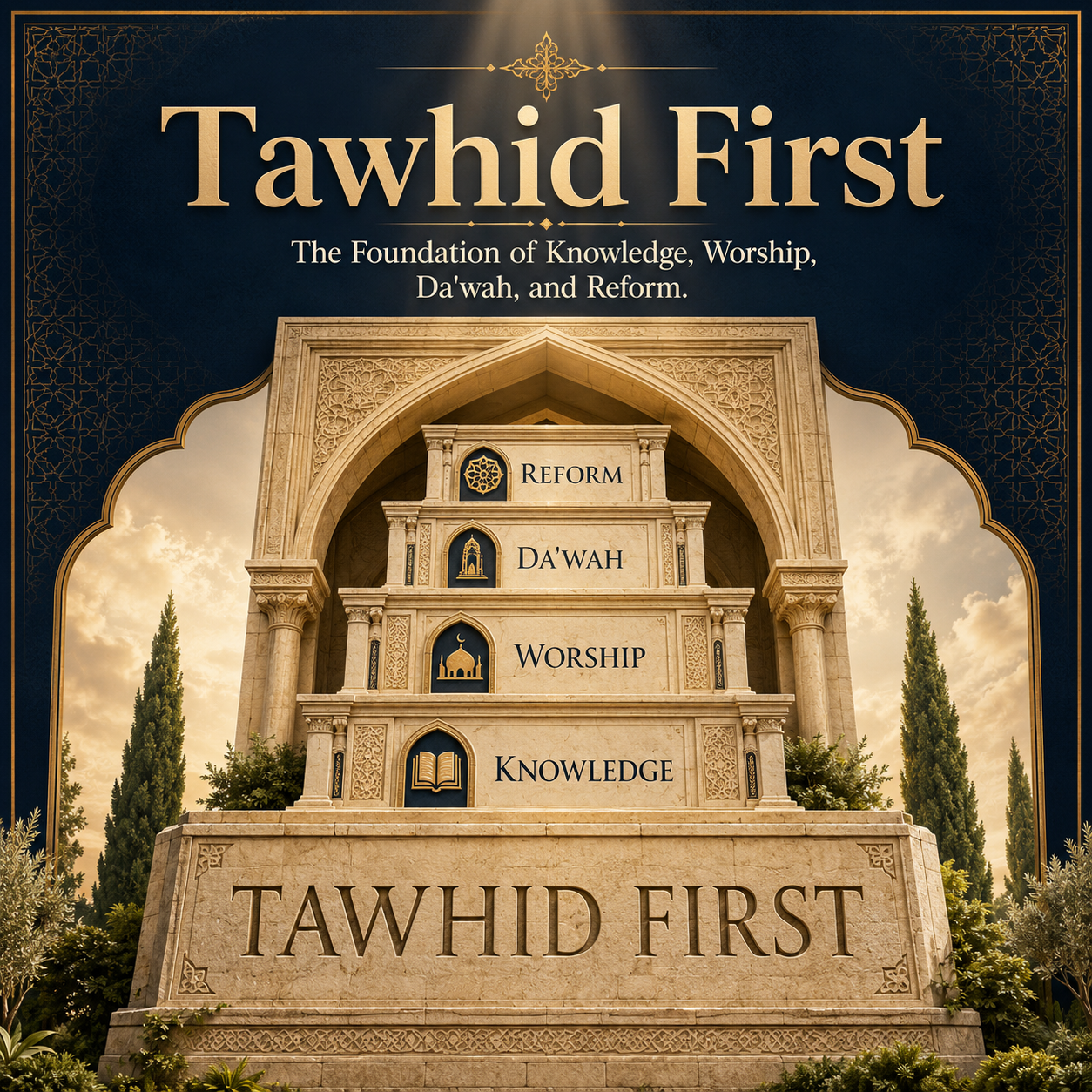
Tawhid First: The Foundation of Knowledge, Worship, Daʿwah, and Reform
A longer study of Tawḥīd’s place in learning, worship, daʿwah and reform.
Read the article
What Is Tawhid?
Explore its meaning and the three inseparable categories: Allah’s lordship, His names and attributes, and worshipping Him alone.
Read the articleEnter the Sciences of Islam
Choose the subject you need to deepen, and return to your foundations as your knowledge grows.
Find the Guidance for Your Audience
Choose the route that fits your family or teaching role. The hubs include planning and curriculum outlines; some full lessons remain in preparation.
Children
An age-conscious route for parents and teachers introducing belief, worship and character.
Youth
Guidance and curriculum outlines connecting sound belief with the questions and responsibilities of growing up.
Parents
Support for cultivating faith, worship and character in family life.
Educators
Teaching principles and curriculum planning for careful, gradual learning.
Pause and Ask Allah
ربنا لا تزغ قلوبنا بعد إذ هديتنا وهب لنا من لدنك رحمة إنك أنت الوهاب
Translation of the Meaning
Our Lord, do not let our hearts deviate after You have guided us. Grant us mercy from Yourself; You are the Bestower.
Qur’an 3:8 · Explanatory translation of the meaning. The supplication of those firmly grounded in knowledge.
The Scholars Explain
توفقنا بها للخيرات وتعصمنا بها من المنكرات
“Through it, You enable us to do good and protect us from wrongdoing.”
Al-Sa‘di explains that those firmly grounded in knowledge ask to remain upon the truth and for mercy that enables good and protects them from wrongdoing.
Al-Sa‘di, tafsir of 3:8 · explanation and translation of the quoted phrase.


The Scholars Explain
وهو معرفة الحق والعمل به
“It is knowing the truth and acting upon it.”
Al-Sa‘di explains that guidance includes knowing the truth and acting on it, both entering the straight path and remaining rightly guided in its details.
Al-Sa‘di, tafsir of 1:6 · explanation and translation of the quoted phrase.